
Boring is Beautiful
September 18, 2026

Why is your investment philosophy so . . . boring?
We are often asked why we don’t offer a more aggressive investing option. It’s an understandable question. In recent years, a high-beta, aggressive allocation tilted heavily toward tech names would have worked great. The Nasdaq has easily outpaced the S&P 500 this decade.
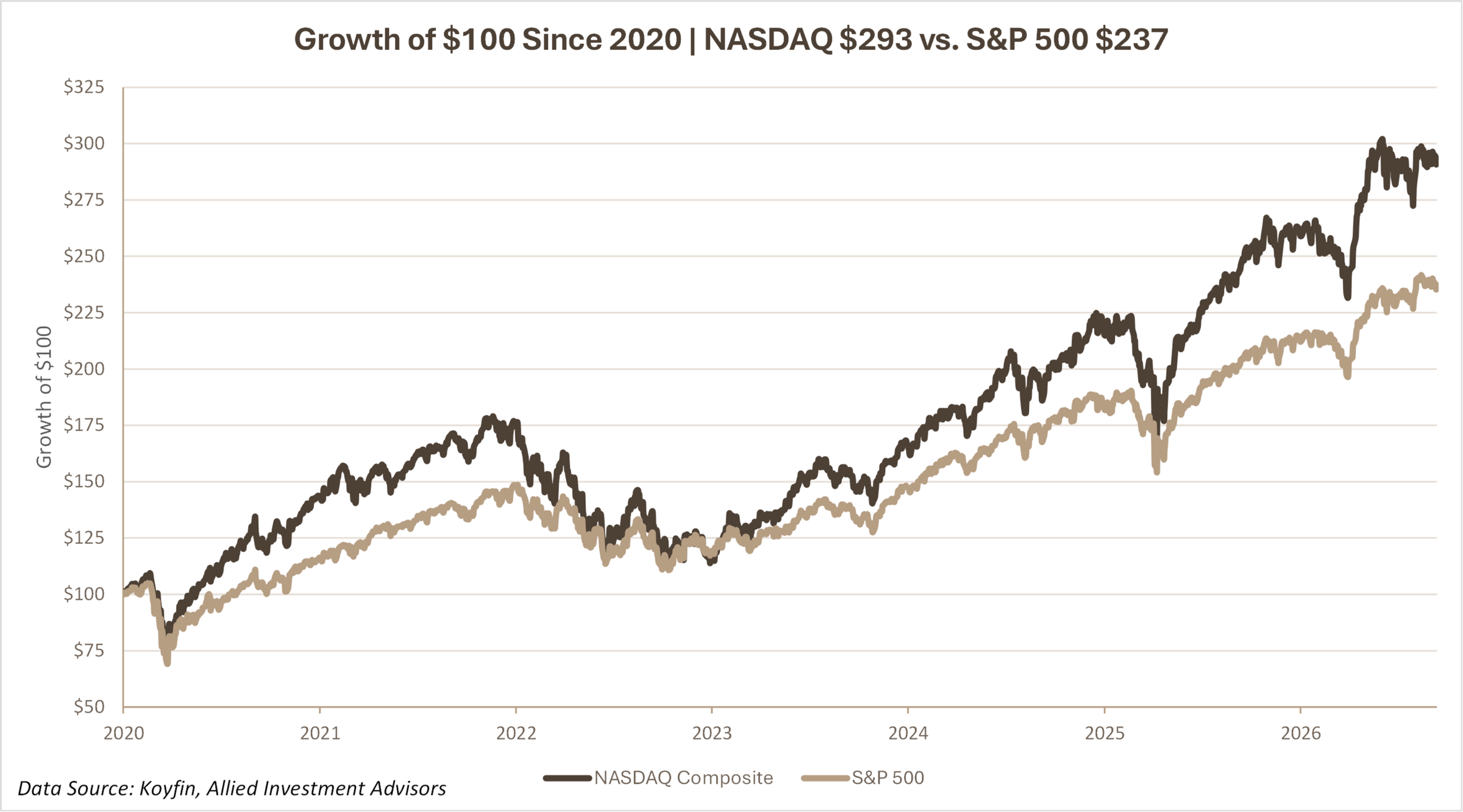
Higher risk should, in theory, equal higher return. For younger investors who are decades away from retirement, short-term volatility shouldn't derail their strategy. As long as market turbulence comes with outsized gains, aggressive allocations seem like the obvious choice.
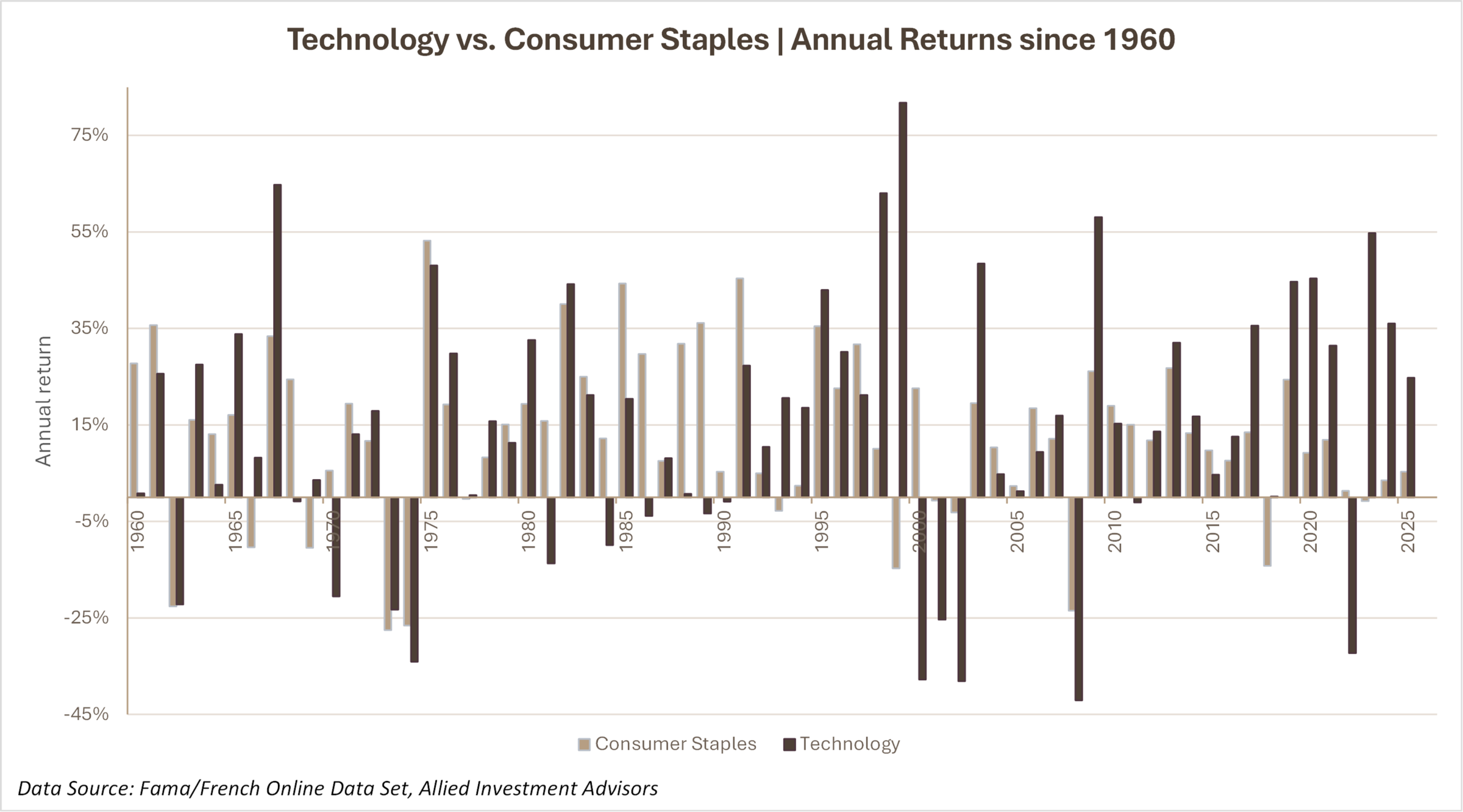
Take technology stocks—the engine of most aggressive portfolios—and compare them to consumer staples, the boring essentials of everyday life. Since 1960, tech stocks have outpaced staples in 36 out of 66 years (55% of the time). Even better, technology has generated a higher simple average annual return of 14.3% compared to 12.8% for staples. Tech investors endured far more volatility, but on the surface, it looks like they were compensated for it.
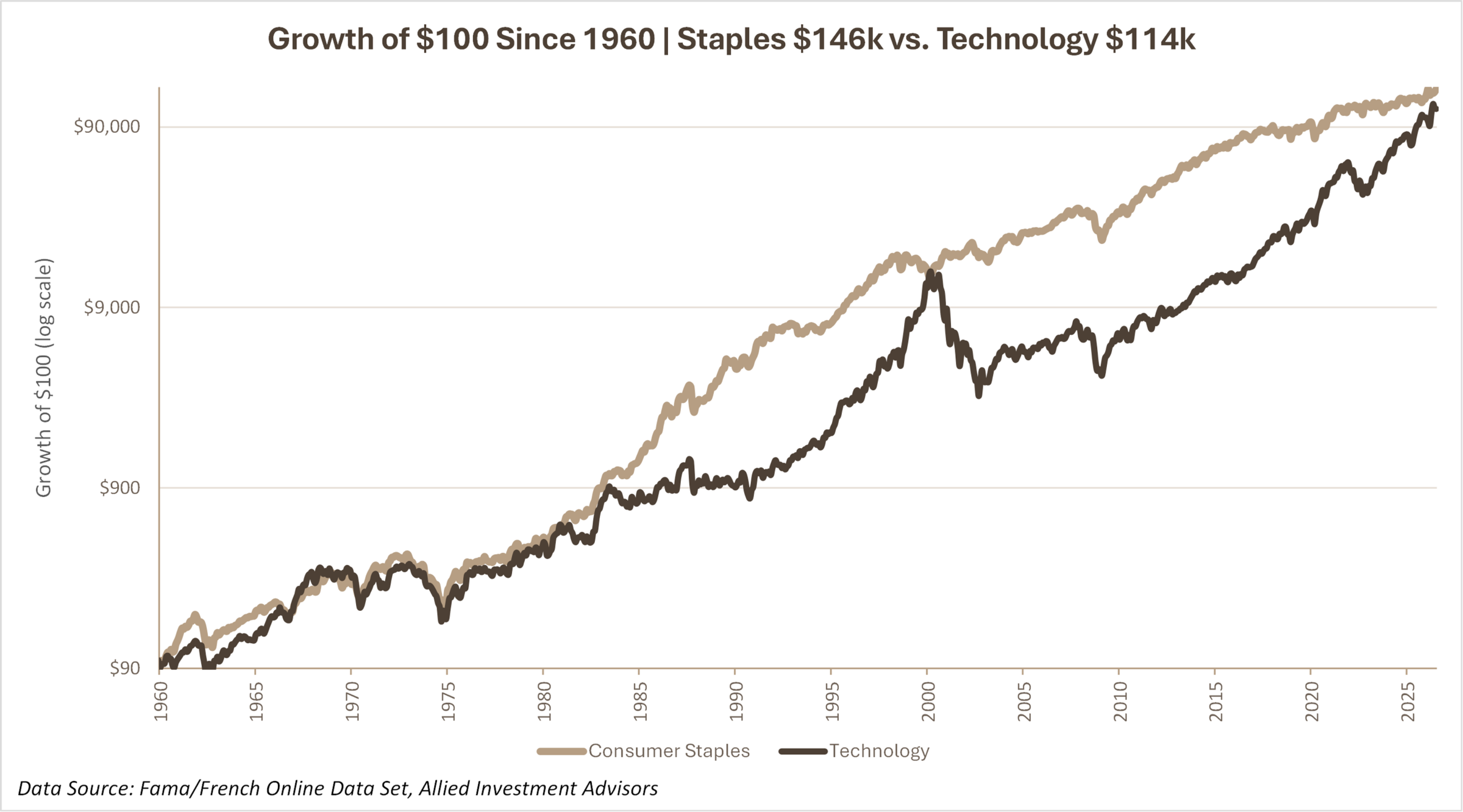
But here is the paradox of market math: despite tech's higher hit rate, higher average annual return, and undeniable excitement, consumer staples have actually compounded at a higher total rate over the long haul.
How can a lower average return generate more actual wealth? Because simple averages lie; compounding pays you in dollars, not averages. If a stock drops 50% in Year 1 and gains 50% in Year 2, your simple average return is 0%. But your wallet tells a different story: your $100 dropped to $50, then recovered to just $75—a -25% real loss.
This math reveals a fundamental truth: compounding favors the mundane over the magnificent.
Big drawdowns inflict far more mathematical damage than equivalent gains can repair. Because tech suffered far deeper market crashes, it required massive rallies just to break even—allowing the steady, low-volatility returns of staples to compound into a bigger final nest egg. During the 2008 Great Financial Crisis, tech fell -42%, while staples proved relatively defensive at -25%. Similarly, in the 2022 bear market, tech dropped -32% while staples actually finished the year up +1.3%. (We detailed the math behind this dynamic in our post, The Tortoise and the Hare.)
Survivability is a key element of long-term investing. To reach your financial destination, you must survive the journey. While aggressive portfolios dangle high average return numbers, drawdowns and human psychology work against you.
To see how this math impacts real-world behavior, look at Amazon. We all like to imagine buying the stock at its IPO in 1997 and holding a once-in-a-generation winner.
What we conveniently forget is that Amazon stock collapsed -94% in the dot-com crash of 1999–2001. (It also suffered a -65% drawdown in 2008 and a -56% drop in the 2022 bear market, along with numerous other pullbacks). Watching a $100,000 investment shrink to $6,000 in under two years is a psychological blow few investors survive without selling at the bottom. And even if you held on, would you have had the fortitude to wait nearly 10 years (from December 1999 to October 2009) just to break even?
Consumer staples—along with other quality, durable businesses we prioritize in building portfolios for our clients—may lack the glamour of hyper-growth tech stocks. But their drawdowns are often more manageable, helping protect you from impossible decisions when markets turn ugly. Avoiding those panicked moments is central to long-term compounding, and it guides every portfolio decision we make.
Or, as Nobel Laureate Paul Samuelson famously put it: “Investing should be more like watching paint dry or watching grass grow. If you want excitement, take $800 and go to Las Vegas.”
If you have questions about your accounts, have experienced a change in your financial situation or investment objectives, or would like to schedule a complimentary consultation, please contact us at (406) 839-2037. We would be glad to discuss how our team can help you navigate the market and pursue your long-term financial goals.